Nobody comes in asking about their legs first. It usually surfaces at the end of a consultation about something else, almost as an afterthought, often with an apology attached.
Spider veins are extremely common, they’re not a character flaw, and in the desert they’re harder to ignore than most places. When you’re in shorts and swimwear from March through November, “I’ll just wear pants” isn’t much of a plan.
Here’s how sclerotherapy actually works, what it can and can’t fix, and who shouldn’t have it.
Not all leg veins are the same thing, and the distinction determines whether we can help you or whether you need a vein specialist.
| Vein type | Size | Can sclerotherapy treat it? |
| Spider veins | 1 mm or less | Yes – this is the primary indication |
| Reticular veins | 1 to 3 mm | Yes – often treated alongside spider veins |
| Varicose veins | Over 3 mm | No – not studied at this size; needs a vein specialist |
Spider Veins : Are the fine red, blue, or purple threads sitting just under the skin surface, usually on the thighs, calves, or ankles. Medically, these are veins measuring 1 mm or less across. They’re a cosmetic concern, not a medical one.
Reticular Veins: Are the slightly larger blue-green vessels, 1 to 3 mm, that often feed into spider veins. These sit a bit deeper. Treating them often improves the spider veins around them, which is why a good treatment plan addresses both.
Varicose Veins: Are the large, rope-like, often bulging vessels. Anything above 3 mm falls outside what Asclera is approved to treat, since it hasn’t been studied in vessels that large. If you have bulging veins, aching, swelling, heaviness, or skin changes around the ankle, that’s a vascular problem and it needs a vein specialist, not a med spa. We’d rather tell you that at the consultation than take your money.
The Honest Summary: Sclerotherapy is excellent for the fine stuff, useful for the mid-sized stuff, and wrong for the big stuff.
Asclera is the brand name for polidocanol, a sclerosing agent that has been FDA-approved since 2010 specifically for uncomplicated spider and reticular veins in the legs.
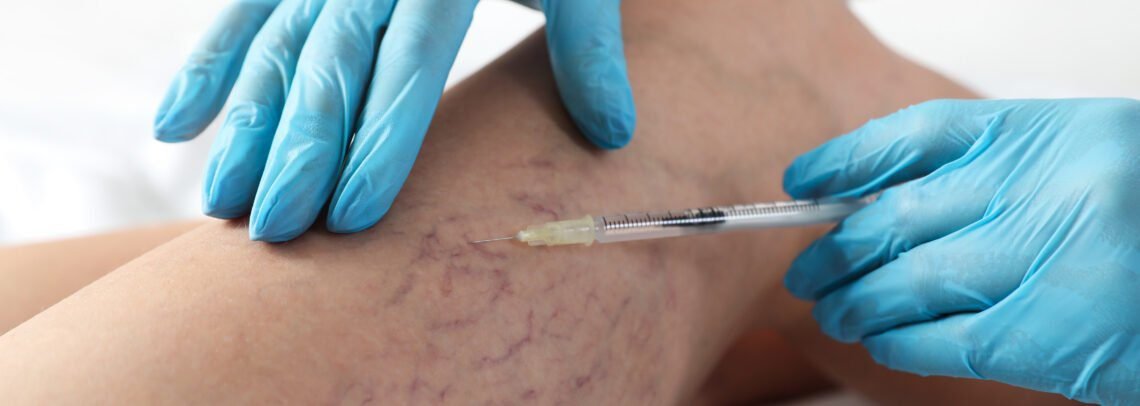
The mechanism is simpler than people expect. A very fine needle delivers a small amount of solution directly into the vein. The solution irritates the vessel’s inner lining, which causes the vein to spasm, close, and stop carrying blood. Over the following weeks, the closed vessel is broken down and absorbed by your body, and healthy tissue replaces it.
The blood that used to travel through it simply reroutes through deeper, healthier veins. Legs have far more venous capacity than they need, which is why removing a surface vein doesn’t cause circulation problems.
Treatment usually runs 15 to 45 minutes depending on how much area we’re covering. No anesthesia is needed.
You’ll lie down and we’ll work through the target veins systematically, using a very fine needle. Most people describe a mild sting or cramping sensation that fades within seconds. It’s substantially less uncomfortable than most people brace for, and considerably easier than a tattoo for perspective.
Afterward, you’ll put on compression stockings and then walk for about 15 to 20 minutes before you leave. The walking isn’t optional and it isn’t busywork; it moves blood through the deep veins and reduces clot risk.
Then you go about your day. There’s no sedation, so you can drive yourself home.
This is where expectations most often go wrong.
Your legs will look worse before they look better. For the first couple of weeks you can expect bruising, small raised bumps along the treated veins, and sometimes a brownish discoloration where the vein used to be. This is normal and it’s part of the process. But if you’re picturing clear legs the following weekend, you’ll be upset.
Realistic Timeline:
Improvement can start showing at around two weeks and keeps building over roughly three months. Judge your results at three months, not at three weeks.
Plan around this: If you have a wedding, a reunion, or a beach trip, book at least three months ahead. Ideally four.
Usually two to four for a given area, spaced a few weeks apart.
One session rarely clears everything. Veins vary in size and depth, some need a second pass, and new ones may become visible once the prominent ones are gone. That’s not treatment failure, it’s how the process works.
Extensive spider veins across both legs will need more sessions than a small cluster on one thigh. We’ll give you an honest estimate at consultation rather than a number designed to get you in the chair.
Aftercare
Compression Stockings: Wear them as directed, typically for several days and longer if we treated reticular veins. This is the single biggest factor in how well your result turns out, and it’s the instruction people most often skip.
Walk Daily: Fifteen to twenty minutes right after treatment, then keep moving over the following days.
For Two to Three Days, Avoid: heavy exercise, hot baths, saunas, hot tubs, and sunbathing.
Skip Long Flights: for a few days after treatment.
Sun Protection Matters Here: Treated skin is prone to temporary hyperpigmentation, and desert UV will make it worse and slower to fade. Cover the area or use SPF religiously.
Contact Us: about severe pain, an area that becomes hot and swollen, a spreading rash, or skin breakdown at an injection site.
Most people get bruising, mild swelling, temporary itching, and some redness at the injection points. Those resolve.
Hyperpigmentation: Brown staining along the treated vein occurs in a minority of patients. It usually fades over several months but can occasionally persist longer. Sun exposure makes it more likely.
Matting: A fine network of new tiny vessels appearing near the treated area. Usually resolves on its own; sometimes needs further treatment.
Skin Injury: If solution leaks outside the vessel, it can cause a small ulcer that heals but may leave a mark. This is rare and largely comes down to injection technique.
Allergic Reaction: Severe allergic reactions to polidocanol, including anaphylaxis, have been reported and can be serious. They are rare, and risk rises with larger volumes, which is why a careful provider uses the smallest effective dose and keeps you under observation after treatment. Any practice offering this should be equipped and prepared to manage a reaction.
Blood Clots: Uncommon, and the compression-plus-walking protocol exists specifically to reduce this risk. Follow it.
Asclera is contraindicated if you have a known allergy to polidocanol or an acute thromboembolic condition, meaning an active blood clot.
Beyond that, we would defer or decline treatment if you’re pregnant or breastfeeding, have a history of DVT, are on certain blood thinners, have an active infection or open wound in the treatment area, or have significant varicose disease that needs vascular evaluation first.
If you’ve had unexplained leg swelling, or your veins ache and feel heavy at the end of the day, mention it. That pattern points toward underlying venous insufficiency, and treating the surface veins without addressing the cause means they’ll return quickly. In that situation the right advice is a vein specialist first, us second.
Read More:
Non-Surgical Face Lift: Everything You Must Know
Two things make this a bigger deal in the Coachella Valley than in most places.
Legs are visible most of the year. Shorts, dresses, swimwear, and golf attire don’t leave much cover, and the season runs long.
And the sun is relentless. That matters for aftercare specifically, since post-treatment hyperpigmentation is the most common cosmetic complaint and UV exposure is what makes it stick around. If you’re treating veins here, you have to be serious about covering the area while it heals.
We’ll look at your legs, tell you what’s treatable, give you a realistic session count, and tell you plainly if what you have needs a vein specialist instead of us. Consultations are free.
A. Mild stinging or cramping for a few seconds per injection. Most people find it easier than expected.
A. Yes. Just no gym, no sauna, no hot bath for a couple of days.
A. The treated vein won’t. New ones can form over the years, since the underlying cause doesn’t change. Occasional maintenance is normal.
A. Not when it’s cosmetic. Treatment for medically significant varicose veins sometimes is, but that’s a different treatment with a different provider.
A. Not with this. Asclera is approved for the lower extremities. Facial vessels are usually addressed with light or energy-based devices.
A. Three months minimum, four to be comfortable. Bruising alone rules out anything sooner.
© Copyrights 2026 Pure Perfection MedSpa. All rights reserved.
Powered by DevZeo


