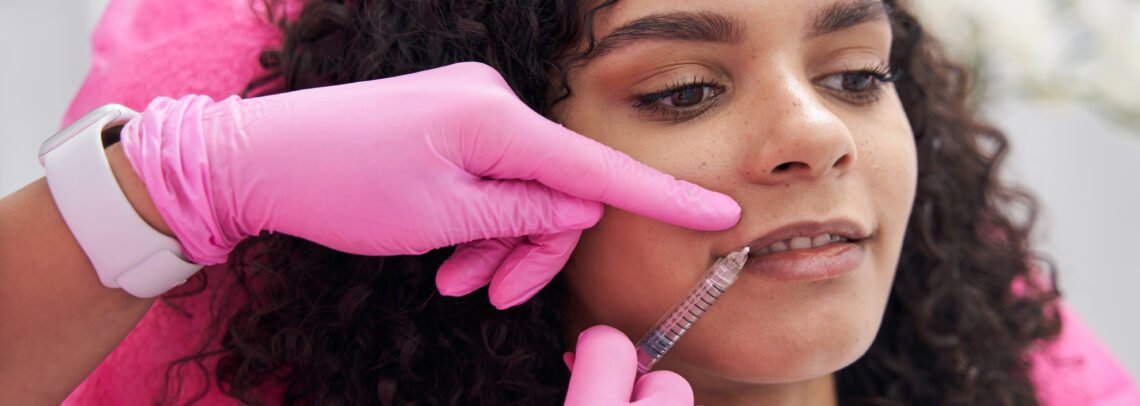
Most med spas would rather not write this article. Talking about undoing filler means acknowledging that filler sometimes needs undoing.
But it’s one of the most searched questions in aesthetics right now, and the people asking it are often anxious, sometimes embarrassed, and frequently coming from somewhere else. They deserve a straight answer rather than a page of marketing.
Here’s how dissolving actually works, when it’s the right call, when it isn’t, and what the real risks are.
Hyaluronidase is an enzyme that breaks down hyaluronic acid. Your body already makes it, as part of normal tissue turnover.
As an injectable drug it has been in medical use for over sixty years, mainly to help other injected medications spread and absorb through tissue. Several preparations exist in the US: Hylenex is a recombinant human form, while Vitrase and Amphadase are derived from sheep and cattle respectively. Hylenex is the one most commonly used in aesthetics.
One honest point of clarification: using hyaluronidase to dissolve cosmetic filler is an off-label application. The enzyme is FDA-approved, but not specifically for this purpose. It’s a well-established, widely accepted use across the industry, but “off-label” is accurate and you should hear it from your provider rather than discover it later.
This matters enormously and it’s where a lot of confusion lives.
| Product | Type | Can Hylenex dissolve it? |
| Juvederm, Restylane, RHA, Belotero | Hyaluronic acid | Yes |
| Sculptra | Poly-L-lactic acid | No |
| Radiesse | Calcium hydroxylapatite | No |
| Bellafill | PMMA (permanent) | No |
If you had a non-HA product and you’re unhappy, dissolving isn’t an option, and that’s precisely why we steer first-time clients toward reversible products.
If you don’t know what you were injected with, that’s a problem worth solving. Ask your previous provider for your records. Any legitimate practice keeps them.
This is the big one, and it’s most common in lips. Product moves outside where it was placed. You’ll see a shelf or ridge above the lip border, a puffiness in the area between lip and nose, or a lip that looks like it extends beyond its own outline. It happens with overfilling, with product placed too superficially, or with repeated treatment before previous filler has resolved.
Cheeks that look heavy or shelf-like, especially in overhead light. A face that reads as wider than it used to. Under-eyes that look puffy rather than smooth.
Discrete firm areas that don’t settle after the expected few weeks.
That doesn’t resolve on its own.
A bluish-grey cast where HA filler sits too close to the skin surface, most often under the eyes. It’s a light-scattering phenomenon, and no amount of concealer fixes it. Dissolving does.
This is the emergency. If filler enters or compresses a blood vessel, blood supply to that tissue is compromised, and hyaluronidase is the treatment. It’s time-critical: hours matter, not days. Signs include severe or disproportionate pain, blanching or white patches, dusky or mottled skin, and, if the eye is involved, vision changes. This is why every injector should keep hyaluronidase on site, and why you should ask before you’re treated, not after.
Entirely legitimate. Trends shift, faces change, and plenty of people decide they’d rather look like their unfilled selves. You don’t need a clinical justification.
Filler needs about two weeks to settle. Judging a result at day four and reaching for the dissolver is a mistake we see regularly. Wait it out.
Sometimes the right answer is adding a little, not removing everything.
Dissolving and refilling repeatedly, hoping the next round is different, usually isn’t the answer. If nothing has satisfied you across several rounds, the honest conversation is about goals rather than product.
If you’re eighteen months out, waiting may cost you nothing.
Outside of an emergency, a small test dose goes into the forearm and we wait about twenty minutes to watch for a reaction. Allergic reactions to hyaluronidase are uncommon but they do occur, and skipping this step isn’t worth it. In a true vascular emergency, treatment proceeds immediately, because the risk calculus is completely different when tissue is at stake.
Small amounts of enzyme are placed into or near the filler deposit. It typically stings more than filler injections did. It’s brief.
You’ll Swell:
Often substantially, especially in lips. This surprises people who expected the opposite.
Especially for large volumes or dense product. A complete reversal often takes more than one appointment, spaced a couple of weeks apart.
The timeline
The enzyme starts working almost immediately and continues acting for several hours after injection.
Do not judge anything in the first three days. People panic on day two constantly.
Expected, resolves.
Uncommon but real, which is what the patch test is for. Reactions range from local redness to, rarely, something more serious. Your provider should be prepared to manage it.
Hyaluronidase can’t perfectly distinguish between filler HA and your own. Some of your natural hyaluronic acid in the area gets broken down too. In the US, the preparations available are relatively low-dose, and your body regenerates its own HA, so the effect is temporary and generally resolves over weeks. But it does mean the treated area can look temporarily deflated or drawn, more so than your pre-filler baseline.
The enzyme spreads through tissue and isn’t perfectly targeted. Dissolving lip filler may soften nearby filler you were happy with. Precision comes from technique, dosing, and experience.
If you’d had filler for years and dissolve it all, you may see skin that no longer looks like it did before you started. Some of that is aging that happened during those years. Filler was masking a moving baseline, and removing it reveals where you actually are now.
Short version: no, and the internet has made this scarier than the evidence supports.
There are alarming personal accounts online, and it’s fair to acknowledge that a small number of people report prolonged problems. But hyaluronidase has decades of clinical use, the vast majority of people who have filler dissolved recover fully within weeks, and many go on to have filler again afterward with no issue.
What genuinely reduces risk is the same thing that reduces risk in every part of this field: an experienced medical injector, an appropriate dose, a patch test, and a provider who isn’t rushing you.
Most practitioners suggest waiting around two weeks, sometimes longer, so the area settles and the enzyme has fully cleared. Rushing back in defeats the purpose.
A number of people dissolve, wait, look in the mirror, and decide they’re fine. That’s a legitimate outcome, not a failed treatment.
If migration happened, going back to the same product, the same volume, and the same injector will produce the same result. Less product, a different formulation, better placement, or a different injector: something has to be different.
Read More:
Questions to Ask Before Your First Dermal Filler Appointment
How Long Do Dermal Fillers Last? Data-Oriented Complete 2026 Guide
If you’ve recently had filler and you’re experiencing severe pain, skin that’s turning white, grey, or mottled, or any change in your vision, contact your injector immediately or go to an emergency room. Don’t wait to see if it improves overnight. These are the signs of vascular compromise and treatment is time-sensitive.
If your concern is cosmetic rather than urgent, there’s no rush. Take two weeks, see where things settle, and then book a consultation.
Some people come in wanting everything dissolved and leave having decided to wait. Some need a small correction rather than a reversal. Some genuinely need the whole thing undone. We’ll tell you which, including when the answer costs us a treatment.
If your work was done elsewhere, that’s completely fine. No judgment, and no interrogation about who did it.
A. Usually priced by units used, which depends on how much filler is present and where. We quote at consultation.
A. Most people say the sting is sharper but shorter.
A. Yes. Dosing and placement can be adjusted to reduce volume rather than eliminate it. Partial correction is a real option and often the better one.
A. Swelling resolves within about two weeks. If the shape is still wrong at a month, it isn’t swelling.
A. Yes. Bring whatever records you have. If you don’t have any, we’ll assess what we can see and proceed conservatively.
A. The enzyme is cleared within about 24 to 48 hours. What you see afterward is your tissue settling, not ongoing dissolving.
A. No. Only hyaluronic acid products respond to hyaluronidase.
© Copyrights 2026 Pure Perfection MedSpa. All rights reserved.
Powered by DevZeo


