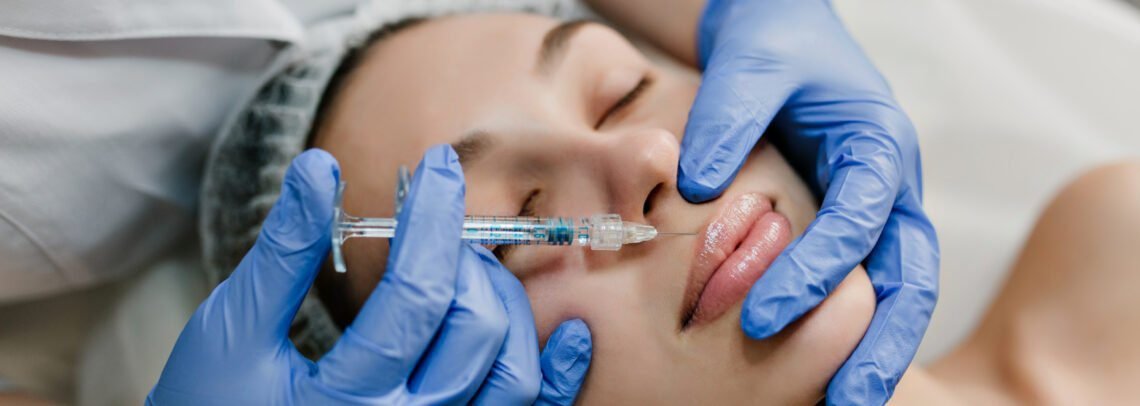
It’s the question we get asked before almost every filler appointment, usually somewhere between “will it hurt” and “will I look like myself.” How long is this going to last?
The honest answer is that it depends, but not in a vague, dodge-the-question way. Filler longevity follows fairly predictable patterns once you know what’s driving it. The product matters. The area matters a lot. And your own body matters more than most people expect.
Here’s what we tell clients at our Rancho Mirage studio, with the 2026 numbers and none of the marketing math.
| Filler type | Typical duration | Common brand names |
| Hyaluronic acid (HA) | 6-18 months | Juvederm, Restylane, RHA, Belotero |
| Calcium hydroxylapatite | 12-18 months | Radiesse |
| Poly-L-lactic acid (PLLA) | Up to 2 years | Sculptra |
| PMMA | 5 years or longer | Bellafill |
| PRF (your own blood) | 6-12 months | Autologous – no brand |
The FDA’s own guidance puts crosslinked hyaluronic acid at roughly 6 to 12 months and calcium hydroxylapatite around 18 months, with individual products in approved studies ranging from 6 months on the soft end up to 24 months for the thicker volumizing gels.
Two people can get the same syringe of the same product on the same afternoon and see completely different timelines. A few reasons for that.
This is the biggest variable, and it surprises people.
Filler placed in an area that moves constantly breaks down faster. Your lips are in near-constant motion: talking, eating, drinking, smiling. All that mechanical movement, plus a rich blood supply, means lip filler metabolizes quickly. Six to twelve months is realistic. Some people are back at nine.
Filler placed deep on bone barely moves. Cheek, temple, chin, and jawline filler sits in a structural plane with less motion and less blood flow, so it holds. Twelve to twenty-four months is common, and the thicker volumizing HA gels are formulated specifically for this.
Rough guide by area:
HA fillers are not one thing. The gels differ in how tightly they’re crosslinked, how thick they are, and how much they resist deformation. A soft gel designed for fine lip lines is engineered to be soft, that’s the point, and it won’t last as long as a dense cheek filler. That’s a feature, not a shortcoming.
Collagen stimulators work on a different clock entirely. Sculptra and PRF don’t fill much of anything on day one. They prompt your own tissue to build collagen over a period of months, which means results appear gradually and then hold for a year or two. If you want something that looks like nothing happened and then quietly improves, that’s the category.
Some people burn through filler noticeably faster. Higher metabolic rate, endurance athletes, people with very low body fat: we see shorter timelines in those groups. If you’re running the Bump and Grind trail four times a week, expect to be on the shorter end of every range above.
Age plays in too. Younger skin with more active turnover tends to clear filler a bit faster.
Under-treating is a real cause of disappointment. If someone needs three syringes of cheek volume and gets one, the result looks thin at four months and gone by eight. Not because the product failed, but because there wasn’t enough of it to begin with. This is one reason we’d rather talk you through a phased plan than sell you a single syringe and let you leave underwhelmed.
Depth, plane, and product selection all affect how long a result holds. Filler placed too superficially can look lumpy and doesn’t last. This is the part you’re really paying for with an experienced injector.
Here’s the thing nobody explains well: filler doesn’t have an expiration date where it vanishes.
HA fillers break down gradually. The gel absorbs water, holds volume, then slowly loses both over months. So at month ten you might still have 40 or 50 percent of the effect. You won’t wake up one morning looking like you did before treatment.
There’s also a compounding effect. People who maintain filler consistently often need less product over time, and the filler itself appears to stimulate some collagen production in the surrounding tissue. Clients who’ve been treated regularly for a few years frequently hold their results longer than they did with their first round.
We’re in Rancho Mirage. Our clients live in a place with intense year-round UV, very low humidity, and a lot of outdoor time. That’s relevant.
Sun exposure accelerates collagen breakdown and degrades skin quality. It doesn’t dissolve filler directly, but it works against the result: the tissue around your filler ages faster, so the overall effect fades sooner. Dehydration matters as well, since HA fillers depend on binding water.
If you live in the Coachella Valley and you’re investing in injectables, daily SPF isn’t optional advice. It’s part of the treatment plan.
Realistic things, not magic:
When should you come back?
A rough maintenance rhythm:
We usually recommend a follow-up two to four weeks after your first treatment in an area. Swelling settles, the product integrates, and that’s the right moment to decide whether a small top-up would finish the result.
Signs your filler is wearing off
You probably won’t notice a single dramatic day. What people describe instead:
If any of these show up around the 9 to 12 month mark, that’s normal, not a failure.
One genuinely useful thing about hyaluronic acid: it’s reversible. An enzyme called hyaluronidase, sold as Hylenex, breaks down HA filler within a day or two.
That reversibility is a real safety feature, not just an aesthetic escape hatch. It’s also why we lean toward HA products for most first-time clients. If you hate it, or if a result migrates, or if something needs correcting, we have an off switch.
Collagen stimulators and PMMA don’t have one. That’s not a reason to avoid them, but it is a reason to be more deliberate about who’s injecting them and where.
Read More:
How to Find the Right Dermal Filler Injector in Palm Desert
Everything above is a range. Your actual timeline depends on your anatomy, your goals, the product we choose, and how much of it you need, which is a conversation, not a blog post.
We do free consultations at our Rancho Mirage studio, and we’re happy to tell you if we think you don’t need anything yet. We see clients from Palm Desert, Palm Springs, and across the desert cities, and the approach is the same for everyone: conservative, honest, and built around what you actually want.
A. Reasonable amounts placed correctly don’t. Very large volumes repeated over many years can affect tissue. This is another argument for conservative, incremental treatment rather than dramatic overhaul.
A. It can, particularly in the lips and particularly with over-treatment or product placed in the wrong plane. Choosing the right product for the area and not overfilling substantially reduces the risk.
A. Yes, and most people do. They address different problems. Botox and Dysport relax the muscles that create movement lines; filler restores volume and structure. They work well together.
A. Often, yes. Regular clients tend to need less product to maintain the same result.
A. Not inherently. The right product for your anatomy and goal matters more than price. A cheap treatment from an inexperienced injector is the expensive option.
A. HA filler is immediate, though swelling means you won’t see the true result for about two weeks. Sculptra and PRF take two to three months to show.
© Copyrights 2026 Pure Perfection MedSpa. All rights reserved.
Powered by DevZeo


